China Southern Institute of Qing History Holds Forum on "Frontiers of Qing History and Jiangnan History Studies"
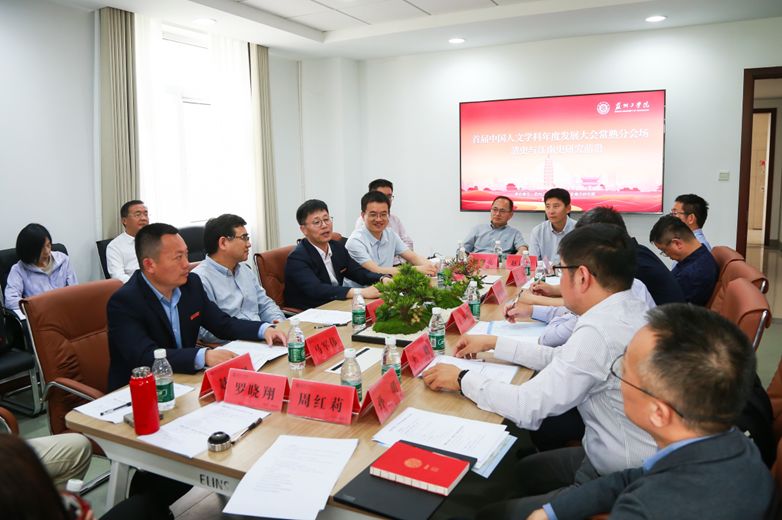
发布:2026-03-10 来源:On May 17–18, the inaugural Annual Conference on the Development of the Humanities(中国人文学科年度发展大会)in China was held in Suzhou, bringing together nearly 200 distinguished scholars from across the country. As a key component of the event, the sub-forum “Frontier Research in Qing History and Jiangnan Studies”(清史与江南史研究前沿) took place on the afternoon of May 18 at the Liben Building of Southeast Campus, Suzhou Institute of Technology. Li Junfeng, Deputy Party Secretary of Suzhou Institute of Technology, attended the event and extended his congratulations to the scholars involved on the successful convening of this activity. The forum was hosted by the Southern Qing History Research Institute. Twelve scholars from seven leading institutions in the field of Qing studies (Renmin University of China, Peking University, Fudan University, Shanghai Jiao Tong University, Nanjing University, Sun Yat-sen University, and Soochow University) gathered for discussions on topics such as Qing political institutions, the socioeconomic history of Jiangnan, intellectual and cultural traditions, and digital Qing history.
The first half of the forum focused on the Frontier Research of Qing History. Professor Huang Xingtao, Dean of Mingde College at Renmin University and a member of the Chinese History Discipline Review Group of the Academic Degrees Committee of the State Council, explored debates between Chinese and Western contributions to late Qing history from the perspective of conceptual history. He highlighted the unique intellectual legacy and familial transmission of scientific knowledge among Jiangnan scholars in modern times. Professor Wang Rigen of the College of History, Culture and Heritage at Xiamen University (also a member of the State Council’s review group), presented seven vivid case studies to illustrate the diversity of lineage society and grassroots governance in Jiangnan district of Qing Dynasty. Professor Wu Tao, Chair of the Department of History (Zhuhai) at Sun Yat-sen University, emphasized that the city of Changshu possesses a wealth of ancient texts and local archives, serving as a rich academic resource for Qing history studies. He also outlined Sun Yat-sen University's accumulated achievements and future directions in Ming–Qing research. Professor Hu Heng—Dean of the School of History at Renmin University of China, Director of the Institute of Qing History, and Director of the Southern Qing History Research Institute—spoke on Qing studies in the age of artificial intelligence. He demonstrated the possibilities of digital humanities for Qing research with the example of the Digital Qing History Laboratory at Renmin University. Professor Wang Han of Soochow University's School of Social Sciences proposed that environmental and social history in the Qing both revolve around human–land relations, reflecting the integrative and interdisciplinary nature of the field. Dr. Sun Ming, Associate Professor at the School of Government at Peking University, used the prominent Wen family (centered on Wen Tonghe) as an example of the possibilities of reconstructing elite social networks for enriching local society studies.
In the second half of the forum, on “Frontier Research in Jiangnan Studies,” Professor Feng Xianliang, from the Department of History at Fudan University, drew on his research on market-town networks of Jiangnan in the Ming and Qing dynasties to reflect on the region's state-building process. He argued that Jiangnan research has always been at the forefront of Qing studies. Professor Huang Hongshan, Dean of the School of Social Sciences at Soochow University, examined operational mechanisms of charitable organizations in Jiangnan from the perspective of social welfare history. Professor Jiang Qin from the Department of History at Shanghai Jiao Tong University recalled the connection between the historian Dai Yi and the university. Associate Professor Zhou Jian of Fudan University reflected on the transformation of the grain tribute (漕运) system in the late Qing, providing insight into larger issues in Qing fiscal policy and statecraft. Professor Zhao Siyuan of Shanghai Jiao Tong University emphasized the importance of placing studies of regional society in the context of shifting relations between localities and the capital. Professor Luo Xiaoxiang of the School of History at Nanjing University drew on his research experience to discuss the significance of close-reading archival materials and of conducting fieldwork。
n his concluding remarks, Professor Hu Heng laid out the strategic vision for the Southern Qing History Research Institute. First, the institute aims to serve as a platform for scholarly exchange on Jiangnan studies. Second, it will work to broaden research methods, build digital platforms and databases, and coordinate efforts with local governments, media, and academic institutions to support and develop the institute.